
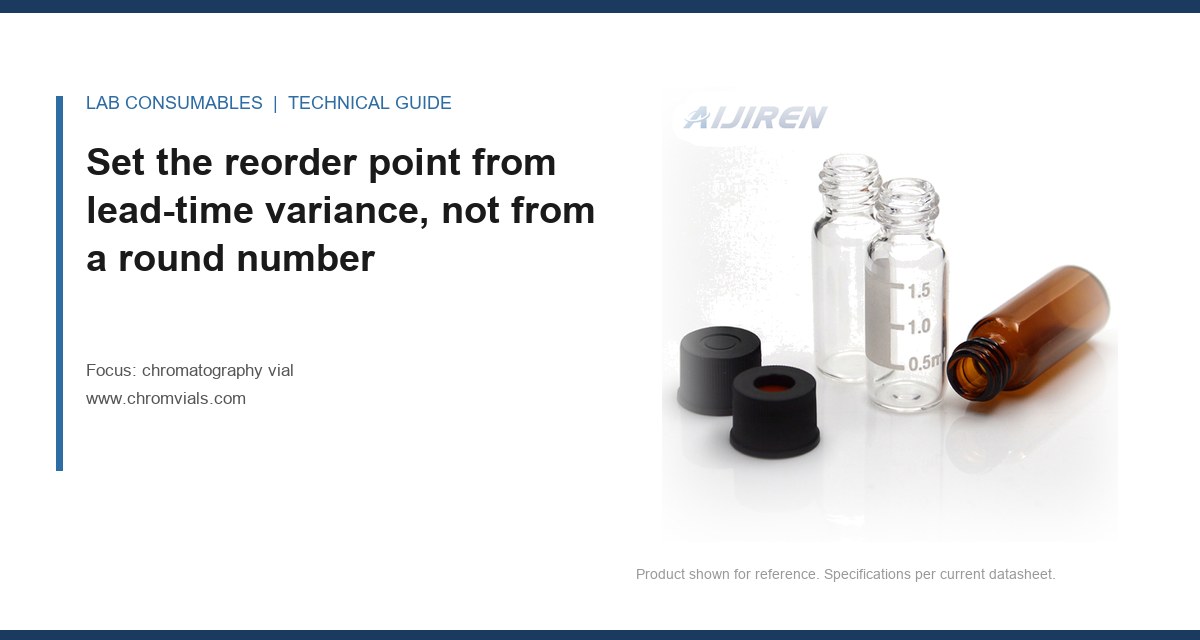
A buyer called me in March because her 9 mm screw-thread vial order had slipped three weeks and her LC-MS batch was down to 11 vials. The root cause was not the vial. It was a reorder point set at 200 units against a consumption rate of 480 per week and a supplier lead time that had drifted from 4 weeks to 7. She had been reordering at 200 for two years because that number "felt safe" when volumes were lower. Three weeks of cover against a seven-week lead time is not safety stock. It is a countdown timer. Chromatography vial MOQ, lead time, and reorder point planning is the part of procurement nobody teaches, and it is where most stockouts actually originate.
The textbook formula is ROP = (average daily consumption × average lead time in days) + safety stock. That formula is correct and almost useless as written, because most buyers plug in a single lead-time number and ignore the variance that actually causes stockouts. Lead time is not a constant. It is a distribution, and the tail of that distribution is what empties your shelf.
Work the numbers. If you consume 480 vials per week (about 69 per working day) and your supplier's quoted lead time is 28 days, your base demand during lead time is 1,932 vials. That is the floor. Now look at the actual lead-time history over your last 12 purchase orders. If the standard deviation is 6 days, then a 95% service level (z = 1.65) requires safety stock of 69 × 6 × 1.65 ≈ 683 vials, giving a reorder point of about 2,615 vials. If your lead-time standard deviation is 12 days because you source through a distributor who back-orders from a factory, that safety stock doubles to roughly 1,366 and the reorder point climbs to 3,300.
That is the whole argument against round numbers. A reorder point of 2,600 looks arbitrary. It is not. It is the demand during lead time plus the buffer that covers your supplier's bad weeks, and it is derived from data you already have in your ERP purchase history.
What you need to record to make the formula work
- Order date and receipt date for every vial PO, not just the invoice date. The gap between PO issue and dock receipt is the lead time that matters.
- Partial receipts flagged separately. A 20,000-unit order that arrives in three shipments over five weeks has an effective lead time of the last shipment, not the first.
- Consumption by vial type, not total vials. A 2 mL clear screw-thread vial and a 1.5 mL amber crimp vial are not interchangeable stock. Pooling them hides the shortage in one SKU behind surplus in another.
- Rejections and quarantine. If incoming inspection quarantines 4% of a lot for septum defects, that 4% is not available stock and should not count toward the reorder point.
I have seen labs carry a single "vials" line item in the ERP and then wonder why the 9 mm screw-thread SKU ran dry while 12,000 crimp vials sat untouched. Split the SKUs. The reorder point is per part number, per thread format, per cap style.
What an MOQ actually does to your carrying cost
MOQ is the number that turns a clean reorder point into a working-capital problem. A factory that runs a 20,000-unit minimum on a custom-colored or custom-labeled vial is not being difficult. The setup cost on a glass forming line, the furnace changeover, and the QC lot release all have to be amortized across the run. Below a certain quantity the run loses money. That is why MOQ exists and why it rarely moves much.
The carrying cost is what buyers underestimate. Standard carrying cost runs 20% to 30% of unit value per year when you count storage, insurance, obsolescence, and the cost of capital tied up in inventory. Take a mid-range vial at $0.18 each and an MOQ of 20,000. That is $3,600 tied up in one SKU. At 25% carrying cost, you are paying $900 per year just to hold that stock. If your annual consumption is 25,000 vials, you are turning that MOQ roughly 1.25 times a year. That is not inventory management. That is warehousing.
| Annual consumption | MOQ | Orders per year | Average stock (MOQ/2) | Carrying cost at 25% ($0.18/vial) |
|---|---|---|---|---|
| 25,000 | 20,000 | 1.25 | 10,000 | $450 |
| 60,000 | 20,000 | 3 | 10,000 | $450 |
| 120,000 | 20,000 | 6 | 10,000 | $450 |
| 25,000 | 5,000 | 5 | 2,500 | $112 |
Read the table across the top three rows. The carrying cost does not change with consumption because the average stock is pinned at half the MOQ. The MOQ, not your demand, is setting your inventory. That is the trap. The fix is either to negotiate a lower MOQ (usually possible on standard 2 mL clear glass in 9 mm screw-thread, rarely possible on custom work) or to accept the MOQ and treat it as a fixed annual commitment you plan around.
When a high MOQ is the right answer
There is a case for taking the big MOQ. If your consumption is stable, your storage is climate-controlled, and the vial is a standard catalog item with no shelf-life sensitivity, a 20,000-unit buy at a lower unit price can beat two 10,000-unit buys. The break-even is straightforward: if the price break on the larger quantity exceeds the carrying cost of the extra stock, take it. At 25% carrying cost and a $0.18 vial, holding an extra 10,000 units for a year costs about $450. If the price break saves more than $450 across the order, the larger MOQ wins. Run that arithmetic before you reflexively ask for a smaller minimum.
The counterargument is shelf life and septum aging. Silicone and PTFE-faced septa do not last forever. A septum that has sat in a warm warehouse for two years can show higher bleed and poorer reseal performance. If your method is sensitive at low levels, a 20,000-unit MOQ that takes 18 months to consume is a slow-motion quality problem. Check the HPLC septa specification for the manufacturer's recommended shelf life and storage conditions before you commit to a large minimum.
Lead time is a stack of lead times, and the longest one is not the factory
Buyers quote a single lead-time number and then get burned by the parts of it they never counted. A chromatography vial order has at least five clocks running, and the factory's production clock is often the shortest.
- Order processing: PO acknowledgment, credit check, and scheduling. Typically 1 to 3 business days, longer if the SKU is not in stock.
- Production or allocation: 5 to 15 business days for standard catalog items from stock; 4 to 8 weeks for a custom run or a color match.
- QC and lot release: 2 to 5 business days. Dimensional checks, septum puncture testing, and certificate of analysis generation all take time.
- Freight and customs: 3 to 10 days domestic, 3 to 6 weeks international depending on mode. This is where the variance lives.
- Incoming inspection: 1 to 3 days if you actually inspect, which you should.
Add those up and a "4-week lead time" quote becomes 6 to 8 weeks of real elapsed time from PO to usable stock. The variance is concentrated in freight and customs, which is exactly why the safety-stock calculation needs the standard deviation of the total, not the quoted production time.
Field case: the customs hold that broke a reorder point
A pharmaceutical QC lab sourced 2 mL amber vials from an overseas factory on a 6-week quoted lead time and set its reorder point at 8 weeks of cover. Consumption was 300 vials per week, so the reorder point was 2,400. Twice in 14 months, a customs inspection added 10 to 14 days to the transit leg. The second time, the lab hit zero stock with a PO in transit and had to borrow 500 vials from a sister site. The measurement that identified the problem was simple: the buyer pulled 14 months of receipt dates and calculated the actual lead-time standard deviation, which came out at 9.5 days, not the 3 days implied by the quoted lead time. Recalculating with z = 1.65 gave a safety stock of 300 ÷ 7 × 9.5 × 1.65 ≈ 672 vials and a reorder point of 3,072. The fix was a reorder point of 3,100 plus a standing 1,000-vial buffer held locally. No stockout in the 18 months since.
A decision checklist for setting the reorder point on each vial SKU
Run this per part number. It takes about 20 minutes per SKU once you have the data, and it replaces the guessing that causes most shortages.
- Consumption rate. Average weekly usage over the last 12 months, excluding one-off projects. Convert to daily.
- Lead-time mean and standard deviation. From actual receipt dates, not quoted lead times. Minimum 10 data points.
- Service level. 95% (z = 1.65) is right for routine work. Use 99% (z = 2.33) for a SKU that would halt a validated method or a regulated release.
- Safety stock. Daily consumption × lead-time SD × z.
- Reorder point. (Daily consumption × mean lead time) + safety stock.
- MOQ check. If the reorder point is smaller than the MOQ, you cannot order to the reorder point. Either negotiate a lower MOQ or accept that the MOQ is your effective order quantity and plan the buffer around it.
- Storage and shelf life. Confirm the vial and septum will survive the storage period at your warehouse temperature. Amber glass and PTFE-faced septa are generally stable; check the certificate for light and humidity sensitivity.
- Dual-source flag. Any SKU where a stockout stops a method should have a qualified second source, even if you rarely use it.
If you are standardizing across a network, the same logic applies to the broader chromatography products list, not just vials. Caps, septa, and inserts have their own consumption rates and their own lead-time tails, and they run out on different schedules. A vial without a cap is not stock.
Where the reorder point calculation goes wrong in practice
Three failure modes account for most of the stockouts I have investigated. None of them is exotic.
Failure mode 1: pooling SKUs
The ERP carries "vials" as one line. The 9 mm screw-thread SKU runs out while the crimp SKU has 12,000 units. The fix is to split the part numbers and set a reorder point per thread format, per volume, per cap style. A chromatography vial in 11 mm crimp format is not a substitute for a 9 mm screw-thread vial in an autosampler that expects the screw format. The instrument does not care that you have stock. It cares that you have the right stock.
Failure mode 2: ignoring the QC quarantine
Incoming inspection quarantines 3% to 5% of lots for dimensional or septum defects. That stock is on the shelf but not available. If you count it in your on-hand figure, your reorder point fires late. The fix is to exclude quarantined stock from the available-to-promise number that the reorder logic reads. A HPLC vial lot that has not passed inspection is not inventory yet.
Failure mode 3: treating the quoted lead time as the real one
This is the customs-hold case above, and it is the most common. The quoted lead time reflects the factory's production schedule. It does not reflect freight, customs, or the distributor's own back-order position. The measurement that fixes it is the actual receipt-date history. Pull it, calculate the mean and standard deviation, and rebuild the reorder point from those numbers. The quoted lead time is a starting point, not a planning input.
Field case: the MOQ that hid a consumption trend
A contract lab bought 11 mm crimp vials in 25,000-unit lots twice a year. Consumption had been creeping up 8% per year as they added methods, but the twice-yearly order cadence masked it. In year three, the second order arrived with only three weeks of stock left because the first order had run out two weeks early. The measurement that caught it was a simple run chart of monthly consumption against the order quantity. The fix was to move to quarterly ordering at 12,500 units, which the supplier accepted once the annual volume was committed, and to reset the reorder point from the updated consumption rate. The smaller MOQ raised the unit price slightly, but the carrying cost fell and the stockout risk dropped to near zero.
What to write into the purchase agreement
Most of the pain in vial procurement is contractual, not technical. Three clauses are worth negotiating on any SKU that matters.
- Lead-time commitment with a remedy. Ask for a committed ship date, not a quoted lead time, and a defined remedy if it slips. A 2% credit on late shipments is enough to get the supplier's attention without souring the relationship.
- MOQ flexibility on the first order. Many factories will accept a lower first order to qualify a new SKU, then hold the standard MOQ on reorders. Ask.
- Lot traceability and certificate of analysis. Every lot should ship with a CoA that ties to the production date, the glass lot, and the septum lot. This matters for the shelf-life question and for any regulated release. The Thermo Fisher chromatography and Aijiren consumables catalogs are useful references for what a complete consumable specification sheet should contain, including the dimensional tolerances and material grades you should be able to demand from any supplier.
For regulated work, the method itself may dictate some of this. If your vial is part of a method governed under U.S. EPA SW-846, the traceability and lot documentation requirements are stricter than for routine work, and that should be reflected in both the contract and the reorder point (a longer QC hold means a longer effective lead time). The Restek technical resources library is a reasonable cross-check for how consumable specifications are documented in practice.
The decision rule
Set the reorder point per SKU from actual receipt-date lead-time data (mean plus z × standard deviation × daily consumption), never from a round number and never from the quoted lead time alone. Treat the MOQ as a fixed commitment and check whether the price break on a larger quantity beats the 20% to 30% annual carrying cost before you accept it. If the MOQ exceeds your reorder point, negotiate it down or plan the buffer around it. And split the SKUs so that a shortage in one thread format cannot hide behind surplus in another. The number that matters is not the price per vial. It is the reorder point that keeps the autosampler loaded.
References & further reading
Related resources from our lab consumables network:
- Chromatography Vial at chromvials.com
- Hplc Vial at hplcvialfactory.com
- Chromatography Products at chromatographyforsale.com
- Hplc Septa at hplcsepta.com
External references and standards: