A 12-position run on a Shimadzu GC-2010 came back with siloxane peaks at m/z 73, 147, 207, and 281 in three of twelve blanks. The septa were silicone, 11 mm, 3 mm thick, and the inlet was running at 280 °C. The lot had been in service for four days. Every blank injected after the fourth day showed the same three-peak train, and the bleed got worse with each subsequent injection. That is not a septa quality problem. That is a material selection problem: silicone at 280 °C in an inlet that sees continuous carrier flow is a wear item, not a barrier. Choosing which chromatography vial material to use for a given solvent and temperature is the single decision that produces more of these failures than any other, and it is also the one most often made from a catalog page rather than a solvent compatibility table.
This is not a piece about glass, dimensions, or price. It is a piece about the polymer system that sits between your sample and the atmosphere: the septa, the liner, and the cap. Get the polymer wrong and you will see it in the data before you see it on the bench. Get it right and the same vial will run 200 injections without a single ghost peak.
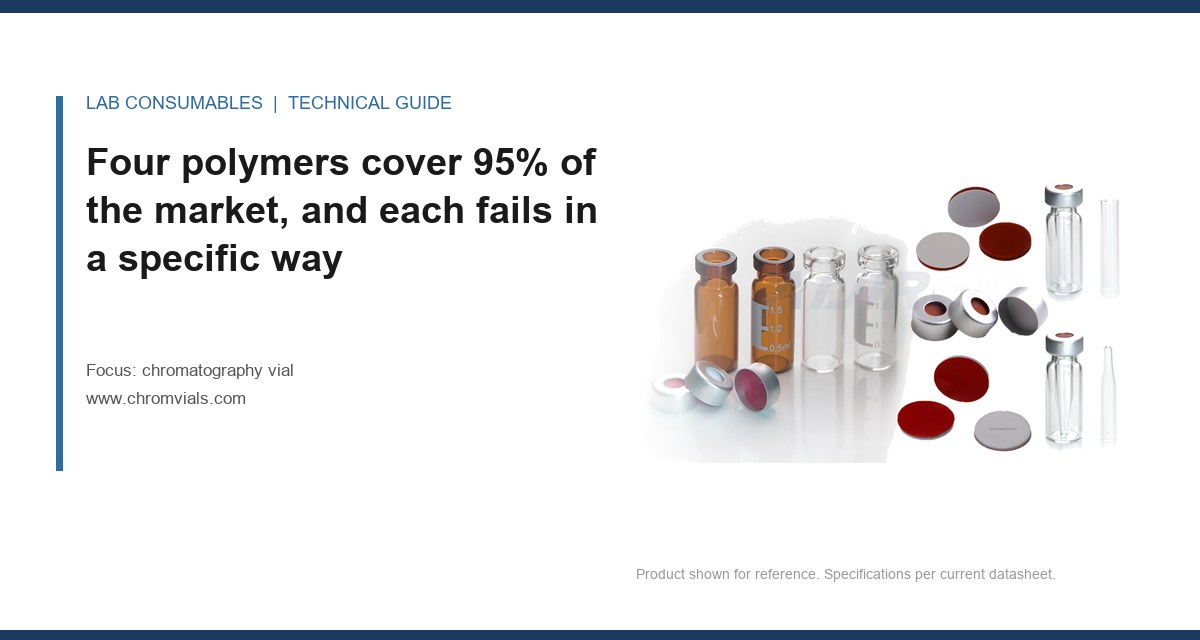
Almost every chromatography vial sold today uses one of four septa materials: silicone, PTFE-faced silicone, EPDM, or a PTFE/silicone laminate. Each has a characteristic failure mode. If you can name the failure, you can name the material.
Silicone: excellent reseal, poor solvent resistance, thermally limited
Pure silicone (polydimethylsiloxane) is the best resealing polymer on the market. A 3 mm thick silicone septa will take 50 to 100 punctures from a 23-gauge needle before the hole fails to close. That is why it is the default on autosamplers running high-throughput sequences. It is also why it is the wrong choice for anything above 250 °C or anything containing a chlorinated solvent.
Silicone swells in dichloromethane, chloroform, and toluene. Swelling is not cosmetic. A swollen septa pushes out of the cap, loses its seal against the neck, and lets solvent vapor escape. The failure signature is a gradual drop in peak area across the run, typically 3 to 8 RSD% drift on the internal standard, with no corresponding change in the sample. At elevated temperature, silicone depolymerizes and produces the cyclic siloxane train (m/z 73, 147, 207, 281, 355) that will destroy a mass spec baseline and confuse any GC-MS library search.
PTFE-faced silicone: the workhorse, with a known temperature ceiling
Bonding a 0.1 to 0.2 mm PTFE film to a silicone core gives you the chemical resistance of PTFE on the sample side and the reseal of silicone in the body. This is the standard septa in most HPLC and GC labs, and for good reason. It resists almost every common mobile phase, holds a seal to 200 °C continuously (250 °C short-term), and takes 50 to 100 punctures.
The failure mode is delamination. The PTFE film is glued or heat-bonded to the silicone, and after repeated puncture at the same spot, the film tears away. The exposed silicone core then contacts the sample. You see this as a sudden appearance of siloxane peaks in a run that was previously clean, usually after 60 to 80 punctures at the same needle position. It is also why you should never reuse a PTFE-faced septa more than once per cap: the film is a one-shot barrier.
EPDM: the aqueous-phase workhorse, the solvent-phase liability
Ethylene propylene diene monomer is a non-silicone elastomer with excellent water and buffer resistance, good thermal stability to 150 °C, and no siloxane background. It is the right choice for aqueous mobile phases, ion chromatography, and any method where a mass spec is looking for low-mass silicone fragments. It is the wrong choice for nonpolar solvents. EPDM swells in hexane, toluene, and THF, and it degrades in contact with concentrated acids.
The failure signature is a slow leak at the cap neck, not at the needle. The septa loses compression set, the cap backs off, and the vial loses 2 to 5 mg per hour by gravimetric evaporation at room temperature. You see it as a rising baseline on a UV detector and as a gradual concentration increase in the vial (the solvent leaves, the analyte does not).
PTFE/silicone laminate: the high-temperature answer, at a cost
A laminate septa sandwiches a silicone core between two PTFE films, or uses a pure PTFE film over a silicone backing. The PTFE side faces the sample. This construction holds to 250 to 300 °C in short-cycle GC inlets and resists essentially all solvents, including chlorinated ones. The trade-off is reseal. A pure PTFE film is stiff; it takes 20 to 40 punctures before the hole fails to close, and the failure is a needle coring event rather than a slow leak. Use a laminate when the inlet is above 250 °C or the sample contains DCM. Do not use it when you need 100+ injections from a single cap.
Solvent compatibility is a swelling question, not a polarity question
The single most useful number for septa selection is the Hansen solubility parameter of the solvent, specifically the dispersion (δD) and polar (δP) components. A polymer swells when its solubility parameters match the solvent's. Silicone has δD around 15.5 MPa^0.5 and δP around 0. PTFE has δD around 18 and δP around 0. EPDM has δD around 16.5 and δP around 2.5. This is why silicone swells in toluene (δD 18.0) and not in water (δD 15.5 but δP 16.0).
You do not need to memorize the numbers. You need to know the failure threshold: any solvent with a δD within ±2 MPa^0.5 of the polymer will swell it by more than 10% in 24 hours. That is the threshold where the septa starts to push out of the cap.
| Polymer | Continuous temp (°C) | pH range | Punctures (23G) | Fails against |
|---|---|---|---|---|
| Silicone | -60 to 200 (250 short) | 3 to 10 | 50 to 100 | DCM, chloroform, toluene, hexane |
| PTFE-faced silicone | -60 to 200 (250 short) | 1 to 14 | 50 to 100 | Delamination after 60 to 80 punctures |
| EPDM | -40 to 150 | 1 to 13 | 40 to 80 | Hexane, toluene, THF, conc. acids |
| PTFE/silicone laminate | -60 to 300 | 0 to 14 | 20 to 40 | Coring at high puncture counts |
The pH range matters less for the septa than for the cap liner. A pure silicone septa is fine at pH 3, but the aluminum cap underneath it will pit and corrode in a pH 2 mobile phase. That is why you see PTFE-faced septa on acidic methods even when the temperature is low: the PTFE protects the cap as much as the sample.
Temperature windows are narrower than the datasheet suggests
Every septa datasheet lists a maximum temperature. That number is the temperature at which the polymer begins to depolymerize or deform, not the temperature at which it performs well. The practical ceiling is 20 to 30 °C below the datasheet maximum. A silicone septa rated to 250 °C is a bad choice above 220 °C in a GC inlet with continuous carrier flow.
The reason is residence time. A septa in a GC inlet sits at the inlet temperature for the entire run, often 30 to 60 minutes, and sees carrier gas flow of 1 to 3 mL/min across its face. That is a continuous thermal load, not a transient one. At 280 °C, a silicone septa will produce measurable siloxane bleed within 4 to 6 hours of inlet time. At 220 °C, the same septa will run for a week.
For HPLC, temperature is rarely the limiting factor. Column ovens run at 30 to 60 °C, and even a heated autosampler compartment rarely exceeds 40 °C. The limiting factor in HPLC is solvent, not heat. That is why the PTFE-faced silicone septa dominates HPLC: it handles the solvent, and the temperature is a non-issue.
For GC, temperature dominates. If your inlet is above 250 °C, you need a laminate or a pure PTFE septa. If it is between 200 and 250 °C, PTFE-faced silicone is fine. If it is below 200 °C, silicone is the best resealing choice and the cheapest.
Field case 1: the siloxane train that was not the column
A contract lab running EPA Method 8270 on a GC-MS started seeing siloxane peaks at m/z 73, 147, 207, and 281 in every blank, with intensities that grew across the run. The column was replaced. The inlet liner was replaced. The gold seal was replaced. The peaks persisted. The lab had been running the inlet at 300 °C with a standard PTFE-faced silicone septa rated to 250 °C short-term. The septa was the source.
The diagnostic was simple: a bleed test with the column disconnected at the inlet, run at 300 °C for 30 minutes with the septa in place, then repeated with the septa removed. The septa-in run showed the siloxane train. The septa-out run was clean. The fix was a PTFE/silicone laminate septa rated to 300 °C, plus a switch to a 1 mm thickness instead of 3 mm (thinner septa, less mass to bleed). Siloxane background dropped by two orders of magnitude and the blanks went clean.
Field case 2: the EPDM cap that lost 4 mg per hour
A pharmaceutical QC lab running an aqueous mobile phase (pH 6.8 phosphate buffer, 5% acetonitrile) on an HPLC-UV method saw a rising baseline and a 2 to 3 RSD% drift in peak area across a 24-hour run. The method used EPDM septa, which was the correct choice for the aqueous phase. The problem was the cap torque: the lab was hand-crimping, and the caps were backing off after 8 to 12 hours in the autosampler tray.
The diagnostic was gravimetric. A sealed vial was weighed at t=0 and every 2 hours for 24 hours. The mass loss was 4 mg per hour at 25 °C, which is consistent with a cap that has lost its compression set. The fix was a switch to a mechanical crimper set to 0.9 to 1.1 N·m torque, plus a switch to a thicker EPDM septa (3 mm instead of 2 mm) to maintain compression. Mass loss dropped to 0.3 mg per hour and the run drift disappeared.
Which polymer for which method: a decision checklist
Work through these in order. The first one that matches is your answer.
- Inlet or autosampler above 250 °C, or sample contains DCM, chloroform, or toluene: PTFE/silicone laminate. Accept the lower puncture count (20 to 40) and change caps more often.
- Inlet between 200 and 250 °C, aqueous or mixed mobile phase, no chlorinated solvent: PTFE-faced silicone. This is the default for most HPLC and mid-temperature GC.
- Aqueous mobile phase, pH 2 to 12, temperature below 150 °C, MS detection looking for low-mass fragments: EPDM. No siloxane background.
- Inlet below 200 °C, high-throughput autosampler, need 100+ punctures from a single cap: pure silicone. Cheapest and best resealing.
- Any method with a chlorinated solvent and a low-temperature inlet: PTFE-faced silicone. Do not use pure silicone.
- Any method with hexane, toluene, or THF: PTFE-faced silicone or laminate. Do not use EPDM.
For the vial body itself, the polymer question is simpler: borosilicate glass (Type I, USP) is the default for HPLC and GC, and the only question is whether you need a silanized or deactivated surface for polar analytes. That is a separate decision from the septa, and it is covered in the chromatography vial selection material on the main site. The septa is where the polymer choice actually matters.
What the standards actually require, and where they leave you exposed
USP <661> covers plastic packaging systems and their materials of construction, and it requires a physicochemical test of the elastomer but does not specify which polymer to use for which solvent. USP <381> covers elastomeric closures and specifies a self-sealing test (puncture and reseal) but not a solvent compatibility matrix. EPA SW-846 Method 8000 series specifies the vial as a container but does not specify the septa material. The result is that the standards tell you the septa must not contaminate the sample, but they do not tell you which polymer will contaminate it. That is on you.
The practical answer is a solvent compatibility test on your own method. Take a blank vial, seal it with the candidate septa, inject a blank, and run the method. Then run the same blank with the septa removed. The difference is your septa background. If the difference is more than 0.5% of your lowest calibration standard, the septa is the wrong choice. This test takes 30 minutes and will save you a week of troubleshooting.
The other standard worth knowing is the GPI 400 finish on the vial neck. A 13-425 cap with a 1 mm septa will seat differently than the same cap with a 3 mm septa. The cap torque that produces a good seal at 3 mm will over-compress a 1 mm septa and cause it to extrude. Match the septa thickness to the cap: 3 mm septa for 13-425 caps, 1 mm septa for 8-425 caps, and always check the compression set after 24 hours.
What to buy, and in what quantity, to avoid the wrong-polymer trap
Most labs buy one septa type and use it everywhere. That is the wrong strategy, and it is the source of most of the failures in this article. Buy three: a PTFE-faced silicone for the default HPLC and mid-temperature GC, an EPDM for the aqueous MS methods, and a laminate for the high-temperature GC. The cost difference is 10 to 20 cents per septa, which is trivial compared to a failed run.
Buy them in lots that match your method volume. A septa has a shelf life of about 2 years from manufacture, and a laminate has a shorter one because the PTFE film can delaminate in storage. Do not buy a five-year supply to get a volume discount. Buy a one-year supply and rotate stock. The HPLC septa reference material on the sister site has the lot-tracking and shelf-life details.
For the vial body, buy from a supplier who can give you the septa and the cap as a matched set. Mixing a 3 mm septa from one vendor with a 13-425 cap from another is a common source of leak failures, because the cap depth and the septa thickness are not independent variables. The HPLC vial catalog and the broader chromatography products listings are useful for cross-referencing part numbers, but the matched-set rule still applies.
If you are running a method that spans multiple solvents (a gradient from water to acetonitrile to methanol), the PTFE-faced silicone is the only septa that handles all three without swelling. EPDM will swell in the acetonitrile fraction. Silicone will swell in the methanol fraction at high organic. The PTFE face is the only barrier that does not care.
The decision rule
Match the polymer to the solvent first, then to the temperature. If the solvent is chlorinated or aromatic, you need PTFE on the sample side (faced or laminate). If the temperature is above 250 °C, you need a laminate. If the method is aqueous and the detector is a mass spec, you need EPDM. If none of those apply, PTFE-faced silicone is the default and it will handle 90% of what your lab runs. The septa is a wear item, not a permanent component: change it when the puncture count reaches 60, when the blank shows siloxane, or when the cap torque drops below 0.9 N·m, whichever comes first. That single rule will eliminate most of the ghost peaks, drift, and blank contamination that get blamed on the instrument.
For reference data on septa compatibility and inlet temperatures, the technical libraries at Aijiren, Thermo Fisher, and Restek are the places to start. The EPA SW-846 method set is the reference for the waste and environmental methods that most often expose septa failures, because those methods run hot inlets and chlorinated solvents in the same sequence.
References & further reading
Related resources from our lab consumables network:
- Chromatography Vial at chromvials.com
- Hplc Vial at hplcvialfactory.com
- Chromatography Products at chromatographyforsale.com
- Hplc Septa at hplcsepta.com
External references and standards: