
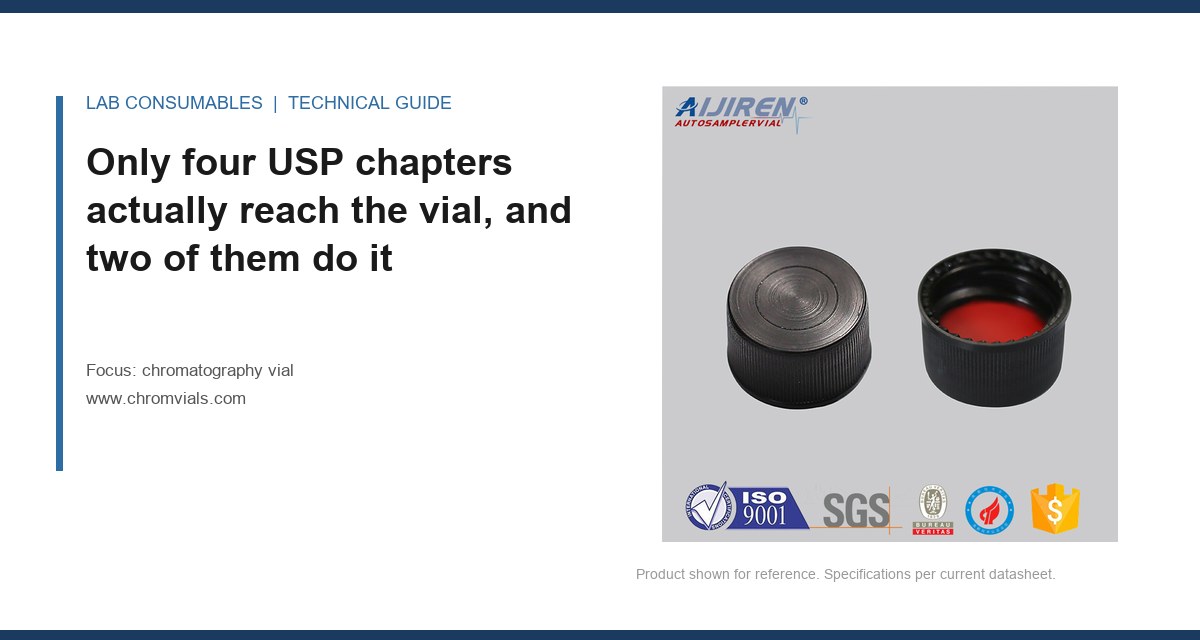
A validated USP method for a small-molecule assay failed system suitability on the third injection of a 96-vial run. The peak area RSD hit 2.4% against a 2.0% limit, and the tailing factor on the analyte drifted from 1.08 to 1.31. The column was six weeks old and fine. The instrument had passed its calibration the same morning. The cause was a lot of 9 mm screw-top vials with a septa durometer about 8 Shore A softer than the previous lot, which let the needle punch a partial plug that sat in the neck and re-sealed between injections. That is the kind of failure a USP method validation does not anticipate, because the vial is not a critical reagent in the method text. It is a consumable, and USP treats it as one. But "consumable" is not "unregulated," and the chapters that reach the vial are more specific than most labs realize.
This article is about which USP requirements actually apply to a chromatography vial in a validated method, what they demand in practice, and where the chapter stops and your own specification has to start. If you already know what a vial is, you are the right reader. The question is not whether USP mentions the vial. It is which chapters reach the consumable, what they require you to demonstrate, and what they leave entirely to you to define.
Only four USP chapters actually reach the vial, and two of them do it indirectly
Most people assume USP has a chapter on vials. It does not. There is no <661> for chromatography vials the way there is for containers used in packaging systems. What you get instead is a chain of chapters that touch the vial through the method, the system suitability test, or the sample preparation, and the chain is short.
The chapters that matter:
- USP <621> Chromatography sets the system suitability framework: tailing factor, resolution, theoretical plates, and repeatability of injection. The vial enters here because the injection repeatability requirement is measured on the vial-instrument system, not on the column alone. If your septa coring or your glass geometry is inconsistent, <621> is the chapter that catches it, because the RSD it demands is measured across injections that pass through the vial.
- USP <1058> Analytical Instrument Qualification is where the autosampler gets qualified. The vial is not the instrument, but the qualification of the autosampler's injection precision depends on the vial you qualify with. If you qualify with one lot and run with another, the qualification does not transfer.
- USP <1225> Validation of Compendial Procedures is where the method's robustness and its sample preparation are validated. The vial is a sample-preparation variable. It belongs in the robustness section, and most labs leave it out.
- USP <1663> Design and Analysis of Forced Degradation Studies and the general chapter on sample handling (<1041> in some editions) touch the vial through extractables and through hold-time, but only when the method involves a hold or a degradant-sensitive analyte.
That is the whole list. No chapter says "use a vial with a 40 Shore A septa and a 1.0 mm wall." The chapters say "demonstrate repeatability" and "demonstrate robustness," and the vial is one of the variables you demonstrate them against.
What <621> actually demands of the vial
<621> requires that the relative standard deviation of replicate injections be no more than 2.0% for a five-injection set in the typical case, or a defined value in the method. The chapter does not say how many vials, which lot, or which septa. It says the injections must repeat. In practice, that means the vial lot used in validation is part of the system, and a lot change is a change to the system. If you validated with a lot of vials whose septa were 45 Shore A and you now run with a lot at 38 Shore A, you have changed a variable that <621> measures indirectly. The RSD is the measurement. The septa is the cause.
I have seen labs try to argue that <621> only covers the instrument. It does not. The injection is the whole path from the needle to the detector. The vial is on that path.
What <1058> means for your autosampler qualification
<1058> asks you to qualify the autosampler for injection precision, carryover, and accuracy. The qualification runs on a specific set of vials. If your qualification protocol does not record the vial part number, lot, septa type, and cap torque, the qualification is not reproducible. I have watched a lab re-qualify an autosampler after a service visit and get a different carryover number, only to find the service engineer had used a different vial lot from the bench stock. The instrument was fine. The vial was not the one the original qualification used. Record the vial in the qualification record, or the qualification does not mean what you think it means.
USP <661> does not cover chromatography vials, and that is a trap
This is the point where a lot of method validation packages go wrong. USP <661> (now split into <661.1> and <661.2> for plastic and glass packaging systems) covers containers for drug products. It is about extractables, leachables, and container closure integrity. It does not cover the chromatography vial, because the chromatography vial is not a packaging system for a drug product. It is a sample container used during analysis.
That distinction matters because procurement and QA sometimes ask for a "USP <661> compliant" chromatography vial. There is no such thing as a <661>-compliant chromatography vial, because the chapter does not reach it. What you can ask for is a vial whose glass and septa have been characterized for extractables under the conditions the method uses, and that characterization comes from the supplier's data, not from a USP chapter pass/fail.
The trap is this: a lab that assumes <661> covers the vial will skip the actual work of characterizing the vial for its own method. Then a method validated on a clean vial lot gets transferred to a lot with a different silicone formulation in the septa, and the analyte shows a small extra peak at the front of the run. The method was validated. The vial was not.
What to ask the supplier for instead
Since <661> does not apply, the practical substitute is a supplier extractables package and a lot-specific certificate. Ask for:
- Glass composition (Type I borosilicate, USP <660> hydrolytic resistance class). Type I is the default for HPLC and GC; Type II and III are for packaging, not for analytical vials.
- Septa formulation, durometer in Shore A, and a statement of silicone cure (platinum-cured vs. peroxide-cured). Platinum-cured is the standard for LC-MS and for any method with a low-level analyte.
- A lot-specific extractables screen in a solvent relevant to your method (water, methanol, acetonitrile, or the method mobile phase) with a detection limit stated.
- Dimensional data: neck ID, mouth OD, and height, with tolerances. These are the numbers that determine whether the vial seats in the autosampler.
If the supplier cannot produce a lot-specific extractables screen, the vial is not qualified for a validated method, regardless of what the catalog says. For more on the dimensional side, the chromatography vial product pages list the tolerances you should be comparing against.
The septa is the part USP <621> actually tests, whether the method says so or not
The septa is where most vial-driven failures live, and it is the component the method rarely names. The two failure modes that show up in system suitability are coring and re-sealing.
Coring is when the needle punches a plug of silicone out of the septa and the plug falls into the vial or sits in the neck. A cored septa shows up as an intermittent extra peak (the plug itself, or material it carries) or as a partial blockage that changes the injection volume. A good septa survives 50 to 100 punctures with a 22-gauge needle before coring becomes visible under a loupe. A soft septa can core at 20. The puncture count is a spec you can ask for and test.
Re-sealing is when the septa closes behind the needle so completely that the vial headspace cannot equilibrate with the autosampler's sample loop, which shows up as a pressure spike or a short injection. It is more common with soft septa and with pre-slit septa that have been punctured many times.
The practical test I run on a new septa lot is simple: 100 punctures with the method's needle gauge, a visual check for coring every 20, and a five-injection RSD on a known standard at the end. If the RSD after 100 punctures is more than 0.5% worse than the RSD at injection 1, the septa is not holding up. That is a lab-level test, not a USP test, but it is the test that keeps <621> from failing on a Tuesday morning.
For septa selection by durometer and coating, the HPLC septa reference covers the durometer ranges and the pre-slit vs. non-slit tradeoff. The short version: 45 to 55 Shore A for standard HPLC, 40 to 50 for GC with a hot injector, and pre-slit only when the method uses a blunt needle.
Why the septa durometer is a method variable under <1225>
<1225> asks you to demonstrate robustness: small deliberate changes to method parameters should not change the result. The septa durometer is not a method parameter in the text, but it is a robustness variable in practice. If a 5 Shore A change in septa durometer moves your tailing factor by more than the method's acceptance criterion, the method is not robust to the vial. The fix is either to specify the septa in the method (lock the durometer and the supplier) or to widen the acceptance criterion. Most labs do the former, because it is cheaper than re-validating.
What USP leaves to your own specification, and how to write it
Here is the honest part: USP gives you the acceptance criteria (RSD, tailing, resolution) and the framework (qualification, validation, robustness), and then it stops. It does not tell you which vial to buy, which septa, which cap, or which torque. That is your specification, and if you do not write it, the vial is uncontrolled.
A specification that survives an audit and a lot change has six lines. I have used this format across HPLC and GC methods and it holds up:
| Parameter | Specification | Why it is there |
|---|---|---|
| Glass type | Type I borosilicate, USP <660> hydrolytic class | Prevents alkali leaching into the sample |
| Vial dimensions | 12 × 32 mm, neck ID 6.0 ± 0.2 mm, height 32.0 ± 0.3 mm | Autosampler seating and needle depth |
| Septa durometer | 45 to 55 Shore A, platinum-cured silicone | Puncture life and re-seal behavior |
| Septa thickness | 1.0 mm ± 0.1 mm | Needle penetration depth and coring |
| Cap torque | 8 to 12 in·oz (0.6 to 0.9 N·m) for screw-top | Seal integrity without crushing the septa |
| Puncture rating | ≥ 50 punctures with 22-gauge needle, RSD change ≤ 0.5% | <621> repeatability under real use |
The torque number is the one most labs get wrong. A screw cap at 15 in·oz crushes the septa and causes coring on the first puncture. At 5 in·oz the cap backs off during the run and the vial leaks. 8 to 12 in·oz is the window for a standard 9 mm screw-top, and a torque screwdriver is the only way to hit it consistently. If you are running crimp-top vials, the crimper setting is the equivalent variable, and it has the same failure modes at both extremes.
For the vial dimensions and the GPI thread reference, the HPLC vial reference lists the standard thread sizes and the tolerance bands. The GPI 9 mm thread is the common one for HPLC; GPI 8-425 and GPI 13-425 show up in GC and in older autosamplers. Get the thread right before you argue about septa.
A decision checklist for accepting a new vial lot
When a new lot arrives, the acceptance test is not a visual check. It is a short run that exercises the variables above:
- Measure 10 vials from the lot for height and neck ID with calipers. If more than one is outside the tolerance band, reject the lot.
- Torque 10 caps to 10 in·oz with a torque screwdriver and check for septa deformation under a loupe.
- Run a five-injection RSD on a known standard in the new lot, and compare to the same standard in the previous lot. A difference of more than 0.3% in RSD is a flag.
- Run 50 punctures on one vial and check for coring. If coring appears before 50, the septa durometer is out of spec.
- Hold the lot for 24 hours at the method's sample temperature and re-check for a front peak or a new degradant.
That is a half-day of work per lot. It is cheaper than a failed validation.
Two field cases where the USP framework caught a vial problem
Case 1: the drifting tailing factor. A contract lab running a USP <621> method for a tablet assay saw the tailing factor climb from 1.05 to 1.28 over a 40-vial run, with the RSD still inside 2.0%. The column was new. The instrument was qualified. The measurement that identified the cause was a septa durometer check on the current lot: it came back at 38 Shore A against a specification of 45 to 55. The soft septa was re-sealing slowly, and the partial seal changed the injection profile as the run progressed. The fix was to reject the lot, re-qualify the autosampler with the correct septa, and add the durometer to the incoming inspection. The method did not change. The vial specification did.
Case 2: the front peak that was not a degradant. A pharma lab validating a stability-indicating method saw a small peak at relative retention 0.4 in the stressed samples but not in the controls. The first assumption was a degradant, and the method was almost re-validated to include it. The measurement that identified the cause was an extractables screen on the vial lot: the septa was peroxide-cured silicone, and the peroxide residues were leaching into the aqueous sample at the method's 40 °C hold temperature. The fix was to switch to platinum-cured septa and re-run the stressed samples. The front peak disappeared. The method was fine. The vial was not characterized for the hold condition, and <1225> robustness would have caught it if the vial had been in the robustness matrix.
Both cases have the same shape: the USP chapter set the acceptance criterion, the lab measured against it, and the vial was the variable. Neither case required a new method. Both required a vial specification.
Where the sibling topics stop and this one starts
I am not going to re-litigate autosampler selection or freight economics here; those are covered elsewhere on the site. The narrow point is that USP compliance for the vial is a specification problem, not a catalog problem. The chromatography products catalog will sell you a vial that meets a dimensional spec. It will not write your <1225> robustness section for you.
What to lock in the method text, and what to leave to the specification
There is a real decision here, and labs get it wrong in both directions. Lock too much in the method and every lot change becomes a variation. Lock too little and the vial is uncontrolled.
My rule: lock the septa formulation and the vial glass type in the method text, and leave the dimensions and torque to the specification. The septa formulation is the variable that changes the chromatogram (extractables, coring, re-sealing). The glass type is the variable that changes the sample (leaching). Those two belong in the method because they affect the result. The dimensions and the torque affect fit and seal, which are caught by the incoming inspection and the <1058> qualification, so they belong in the specification. That split keeps the method stable across lot changes while keeping the vial controlled.
For GC methods with a hot injector, add one more line to the method: the septa's maximum continuous temperature. A standard silicone septa is rated to about 200 °C; a high-temperature septa (often a silicone/PTFE laminate or a specialized blend) goes to 300 °C or higher. If the injector runs at 280 °C and the septa is rated to 200 °C, the septa bleeds and you get a baseline rise that looks like column bleed. That is a method variable, not a vial variable, and it belongs in the method text.
For the broader supplier picture, the Aijiren GC accessories and Thermo Fisher sample handling references list the septa temperature ratings and the autosampler vial dimensions for their platforms. The Restek technical library has a useful septa bleed comparison that is worth reading before you specify a high-temperature septa. And if your method touches environmental samples, the EPA SW-846 methods have their own vial requirements that sit alongside the USP ones, but that is a separate compliance track.
The decision rule
If a USP method is validated, the vial is part of the validated system whether the method text names it or not. The rule I use: any vial lot that differs from the validation lot in septa formulation, glass type, or durometer is a method change until you prove it is not, and the proof is a five-injection RSD within 0.3% of the validation value plus a 50-puncture coring check. Everything else (dimensions, torque, cap color) is a specification item caught by incoming inspection. Write the specification, record the validation lot in the <1058> qualification, and put the septa in the <1225> robustness matrix. Do that and the chapter does the work. Skip it and the vial does the failing, on a Tuesday, at injection three.
References & further reading
Related resources from our lab consumables network:
- Chromatography Vial at chromvials.com
- Hplc Vial at hplcvialfactory.com
- Chromatography Products at chromatographyforsale.com
- Hplc Septa at hplcsepta.com
External references and standards: